The landscape as it actually runs today: the systems, the interfaces, the code, the processes people follow. Modelled from your own material.
Enterprise-wide change, governed end to end.
Forward-deployed engineers, complex integrations, and any initiative, whether a regulation change, a system sunset or a migration, run from the transformation map through two gates to the work packages that land it. Where the initiative replaces a system, it closes with a migration proof checked to the cent. Pick the domains in scope and see the shape of the engagement.
Pick your domains.
Click the wheel or the list. At this scale the domains are usually all of them, in waves.
What you'd send · sources5
Application inventory
Architecture diagrams, as they are
Schema exports per system
Interface catalogue
Job and batch definitions
click a slice, or use the list
What you'd get · deliverables4
The landscape, modelled and anchored
Blast radius for any retirement
Interface dependency graph
Application landscape × Integrations & interfacesWhat a cutover breaks, before cutover
start with documentation · scale with access1 connection unlocked · every change is gated, and auditable while it runs
Before, during and after the programme.
Before the programme
- The dependency map the plan doesn't have
- The blocker list: the named key person, the unprovable data chain, the missing fallback
- What each step touches, computed
While it runs
- Every decision with its consequences shown before the click
- Second signatures where the risk is critical
- Nothing irreversible without a signature, and everything on the record
At the end
- The work packages land, and each one writes its result back into the model
- Where a system was replaced: the migration proof, data checked to the cent, old against new, signed and time-stamped
- Re-checked against live data afterwards, so if the systems drift the proof flags as no longer valid
- Worked end to end on the SAP IBP implementation: the demand model rebuilt with every figure anchored, and the cutover closed with one signed number traced to its three sources
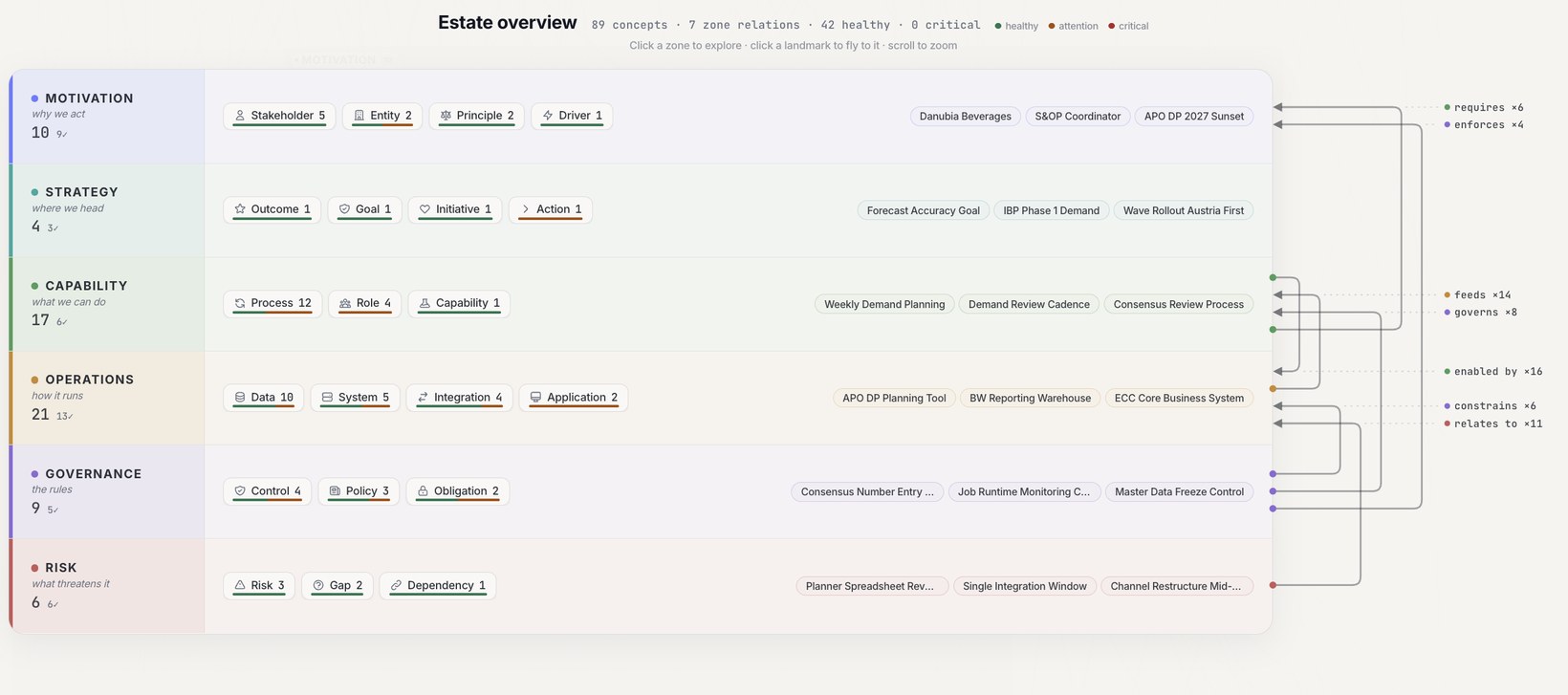
the landscape overviewclick to enlarge ⤢
The three models an initiative runs against.
A regulation change, a compliance audit, a system sunset, a migration or a new product: each one runs against the same three models, and produces the same chain. These are the words the rest of this page uses.
The source world · as-is
The target world · to-be
Where you are going, modelled on the transformation map: the landscape after the regulation lands, after the system is retired, after the product ships. It is held to a higher bar than the other two, because it is the model the decision stands on.
The vendor reference
Where a standard product is involved, the package as it ships, unmodified. It is the ruler you read the other two against.
CharterWhat was decided, frozen and signed. The initiative stays bound to the version of the transformation map it came from, so what the change was for cannot be quietly re-argued later.
BlueprintWhat has to be built or changed to get from the as-is to the to-be. Derived from the two models.
MappingWhich concept on one side answers to which concept on the other. It changes neither state. It is what lets an initiative reason per concept: move it, build it, or decommission it.
GapThe delta between what exists and what should. It is graded: one-to-one, lossy, needs reconciliation, net new, or orphaned: a target object with nothing on the source side to answer it.
The decisionEvery gap gets one decision before it becomes work: migrate, build, decommission, retain, remediate. Which is why an initiative stops arriving as one undifferentiated wall of build tickets.
Work packageA gap with its decision made, scoped and owned. It goes to one of your team, or to an agent with write access to the system it touches. Neither authorises itself. The gate sits upstream of the work.
CutoverWhere an initiative that replaces something becomes real. What survives one-to-one, what degrades, and what has to be built net new, answered before the date.
Fit-to-standardAdopting the vendor model as it ships, and justifying every place you cannot. Read against the reference, the deviations are the deliverable: what your business genuinely does differently, separated from what it does differently by accident.
Change, run through gates, with the proof at the end.
An initiative chartered on the model, executed in waves through two human gates, and closed with a proof that checks itself. Worked example: the SAP IBP implementation, from the demo environment.
01 · CharterThe implementation, chartered on the transformation map
SAP IBP replaces demand planning run on spreadsheets, macros and scheduled jobs. Every step knows what it touches before anything moves.
promo calendar · Exceldemand model macroweekly sales history jobtouches 7 integrations · 3 reports · 1 controlcharter frozen, and signed
Gate one · the domain is published. A named person signs.
02 · Execute in wavesEvery step, with its computed impact
Integrations re-pointed and the demand model rebuilt with every figure anchored. The undocumented +14% planning uplift is surfaced as a named line with an owner.
wave 1 · interfaces: touches 7, breaks 2, owners namedwave 2 · demand model: every figure anchoredevery gap gets one decision: migrate · build · retain · decommission · remediate+14% override: undocumented, now on the record
Gate two · into reality. Two signatures, and the AI never signs.
03 · Parallel runOld against new, on live weeks
The signed forecast is produced by both systems and reconciled. Every delta is explained, with the receipt attached. Nothing irreversible happens without a signature.
deltas explained · receipts attachedevery match proven, and re-checked when it is read
Cutover · gated, and auditable while it runs.
The proofOne signed number, traced to its three sources.
Old against new, checked figure by figure. Signed and time-stamped, then re-checked against live data. If the systems drift afterwards, the proof flags as no longer valid.
signed · countersigned · on the register, receipt attachedAnd when a work package deploys, the model updates in the same step. Keeping the model true is not a maintenance task. It is a by-product of shipping the work.
The roles required from your side.
A sponsor with authority across the enterprise, an owner per domain in each wave, an architect who can arbitrate, and IT once per system. Our engineer sits inside the programme.
Your executive sponsorHolds the second gate across the enterprise, and the authority to overrule a programme that wants to move without one. About half an hour a week.
One owner per domain, per waveHolds the first gate, and gives verdicts only. Owners rotate in as their wave enters scope, so nobody is asked for a year of attention.
Your architectArbitrates when two systems disagree on the same field, and decides which definition wins. That is the one call the platform will not make for you.
A handful of contributors"I don't know" is a legitimate answer and gets recorded as one. One routed question at a time, answered in minutes, asynchronously.
Your IT, once per systemA one-time export per system in scope. No credentials and no live access, and it reads only what you export.
Your programme office, if you have oneThe project list and the milestone plans go in as material. We do not run a governance layer beside yours: the decision register replaces the status report.
Our engineer, embeddedIngestion, linking, findings triage, verdict-session prep and the weekly pulse. Confirming business truth stays with your experts.
The two gates
The publish boundary is held by a named person: a domain goes live only once published. The per-decision gate requires two signatures, from two different people, before anything irreversible happens. At cutover that is what turns a plan into a proof.
You keep everything
The model, the exports, and the signed proof, which stays checkable after we leave, and is re-checked against live data, so if the systems drift it flags as no longer valid. Stop whenever you like and all of it stays yours.
The three plans, side by side.
Same platform underneath. What changes is the scope, the domains that sit in it, who does the modelling and where it runs, and you can move between them as your own team takes more of it on.
Tier 1Consultancy
What it isYour methodology, as a model.
Who models itWe do, for your practice. Your seniors validate the output.
Our peopleWe run the first engagements, then your consultants certify as operators.
Where it runsPer client engagement, under NDA.
What you getDeliverables that generate with evidence attached.
It closes withThe firm's knowledge compounds.
Tier 2Business
What it isModel your own domains.
Who models itYour own team, in the Studio.
Our peopleA fractional engineer: drift, re-certification, onboarding.
Where it runsYour perimeter: our private cloud, your private cloud, or on-premise.
What you getYour domains modelled and queryable by your team, apps and AI.
It closes withOne correction improves every answer that leans on it.
Tier 3Enterpriseyou are here
What it isAny initiative, run on the model.
Who models itYour engineers, embedded with ours.
Our peopleA forward-deployed engineer, embedded for the programme.
Where it runsYour landscape, in waves.
What you getThe transformation map, gated execution, and the work packages that land the change.
It closes withEvery change gated, and auditable while it happens.
Tiers are not module bundles · nothing here is a feature you unlock

Not sure which one is yours?
Answer a few questions and we will tell you. Or hand over your first documents and see for yourself.
Get the fact sheetThis site uses cookies
We use essential cookies for the site to function and analytics cookies (Google Analytics) to understand how you use it. Analytics cookies are only activated with your consent. We do not track you across other websites. Your data is stored in the EU and processed in accordance with GDPR. Read our Privacy Policy

